

Leading Charges: My Dog Training Philosophy
- Liz R. Kover
- May 2, 2014
- 8 min read

As an Associate’s and Master’s student in science-based training methods at Bergin U., and simultaneously a firm believer in what many see as the “opposing”, primal-intuitive practices of pack theorists, I feel I have a well-rounded and unique perspective; one not constrained by the narrow requirements of “choosing a side”.More pointedly, I strive in training to strike a balancebetween what are often seen as opposing ideologies; I see them as complementary elements of a bigger picture instead. Just as Evolution needn’t be the antithesis of Creationism, and Yin needn’t discount Yang in order to justify its own position in the duality of Everything, I feel that a realistic, open, and effective trainer won’t need to bash others’ techniques to bolster her own worth. She will have many “tools in her toolbox” and, thinking critically and instinctively at once, she will determine which tool or tools-in-combination will work best in any given situation.
Leadership
Every one of us — human, canine, or otherwise — has within the ability to evolve into ever-improved versions of ourselves. However, only if our potential is recognized, tapped, and nurtured by the parental figures, teachers, trainers, and mentors in our lives will such an evolution occur. The concept and practice ofleadership runs consistently through the teachings of those who’ve influenced me the most, and is central to my work as a dog trainer. Like team members from their coach, staff from their supervisor, and children from parents, dogs need motivation, guidelines, and loving leadership from their human guardians. In the absence of clearly defined and consistently enforced rules and limitations in combination with a “canine education”, a dog will not have the opportunity to do the right thing, as he will not know what the right thingis. It is our responsibility as humans to teach our dogs what we consider desirable behavior, and compensate them fairly for their attention and effort. It is our job to structure the way our dogs use their time and energy, such that their life force is channeled productively rather than counterproductively, or worse, destructively.
Like many people, I was first introduced to the concept ofpack leadership with regard to dog training when Cesar Millan’s National Geographic TV show, Dog Whisperer, swept the nation in 2004. It made perfect sense when Cesar said, “As a Pack Leader, I am expected to provide protection and direction (Millan, 2013). By the same token, I was shocked to learn of the intense barrage of anti-Cesar Millan rhetoric coming from the “positive reinforcement only” extremists. Victoria Stilwell, who leads the chargeagainst “dog whispering” (or any form of training that doesn’t stem from Strict Behaviorism’s roots), lumps Cesar Millan in with the “traditional” punishment trainers of the dark ages. In my estimation, she misinterprets his teachings, telling her audience in said context, “A dominance-related misdiagnosis of (dogs’) behavior problems usually leads to a worst-case scenario: traditionally prescribed behavior modification techniques usually include punishment, intimidation, and fear (Stilwell, 2013). To the contrary, Cesar says of Pack Leadership: “To positively influence your dog’s behavior, you must always begin by being a positive, confident, calm and assertive human. This is the definition of true leadership” (Millan, 2010). Stilwell claims that Cesar Millan and other trainers who incorporate pack theory – i.e. the naturalistic dynamics between canines and other social animals — into their training practice, see dogs as though they are “in an ego-driven race to become the leaders of the free-world”, and that “it is only when we misinterpret canine behavior that we start to think dogs must be trying to achieve a higher rank than us” (Stilwell, 2013). However, my interpretation is that Cesar Millan is saying, simply, that we must “parent” our dogs. They are family members, integral parts to the whole of our human-canine hybrid social groups. To my mind, this kind of “parental leadership” is the very definition of training.
Social Status
Like others in her camp, Stilwell harps on Millan’s use of terms like “alpha”, and his discussing domestic dogs as related to their distant cousins, the wolves. The term alpha was popularized with regard to the gray wolf by L. David Mech in 1970, and later disavowed by Mech himself, who said his observations of captive wolf groups comprised of unrelated members wouldn’t accurately reflect the behavior of wolves in the wild. What he discovered instead was that the alpha members of a wolf pack are a breeding pair, and they and their offspring form a pack. Mech said of gray wolves, “In our experience, the most usual context of dominance behavior in free-ranging wolves is that of parent to offspring” (Mech, L.D. and Cluff, H.D., 2010). Anti-pack-theorists point to Mech’s recanting of his original declaration as a way of discounting any who incorporate pack theory into their work with dogs, claiming that their practices are “outdated”. However, the whole argument is beyond ironic, considering that domesticated dogs living in the human world, it seems, would likely behave more like captive wolves than wild ones. When placed within human families, domesticated dogs in fact become “captive groups comprised of unrelated members”. Simply stated, the alpha male or female is the member of a group of social animals that holds the highest rank. And if a human doesn’t hold the highest rank in her home, she will not be able to provide structure and guidelines for her family pack — which includes both kids and pets — and chaos will ensue. Whether our pet dogs behave more like wild wolves than captive ones, or it’s the other way around, or their behavior as co-evolutionary counterparts to humans holds the interspecies relationship to an altogether different social standard, it makes sense that the basic rules of parenting would apply.
Says Cesar, “I understand that I use words that make people uncomfortable; the two most common aredominance and control. But when I use these words, I don’t have the same negative associations with them that some do. The word dominance comes from the Latin “dominus”, which just means “master”. To my ears, this word sounds like the Spanish word maestro, which simply means “teacher”. With regard to control: In your relationship with your dog, you, the human, should be the one who determines when things start, change, and stop. If your dog is the one making the decisions then you, quite simply, are not in control. To be a Pack Leader, you must be in control (Millan, 2013).
In her book, How to Be The Leader of the Pack, Patricia McConnell reminds us that the pack leader initiates behavioral change, so any time your dog demands something (“Play with me, now!”, “Pet me, now!”, “Let me out, right now!”) he is promoting himself to camp counselor (McConnell, 2007). A dog’s humans should initiate and direct meal times and level of excitement during play sessions; she should set boundaries about where the dog is and is not allowed to go, and determine the direction and pace of a walk. The human should have reasonable but significant expectations, knowing that she has taught her dog the right way of doing things such that he can, in fact, do things right! Patricia McConnell says “the key is to understand that dogs will work to get something they want…make obedience relevant to life, so that your dog begins to learn: “Oh I see, the way to control my environment and get what I want is to do what she asks” (McConnell, 2007). In preeminent positive reinforcement trainer Sophia Yin’s “Program for developing leadership in humans and impulse control in dogs”, Dr. Yin says “you gain leadership by controlling all the resources that motivate the pet and require the pet willingly work for play, treats and pats instead of getting them for free” (Yin, 2012). Here, Dr. Yin uses terminology that alludes to an animal in a social group (a human) playing a dominant role in a group controlling the resources, and thereby creating order among pack members. Cesar Millan concurs: “Waiting is another way that pack leaders assert their position. Puppies wait to eat, and adult dogs wait until the pack leader wants them to travel. Waiting is a form of psychological work for the dog. Domestication means dogs don’t need to hunt for food, but they can still work for it. Establish your position as pack leader by asking your dog to work” (Millan, 2007).
Energy
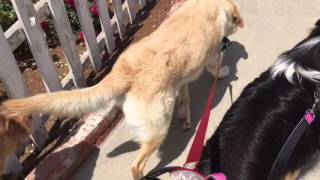
Like humans’ and other social animals’, dogs’ behavior is shaped by dynamics between them and other energetic forces in their environment in any given moment. As is the case with people, dogs’ temperament is not fixed and unyielding, nor does is express itself the same way in every situation or under the auspices of every handler. Energy travels down the proverbial leash, and the behavior of both human and dog while connected, by leash or close proximity, is a feedback loop. Whether the loop is a positive, upward spiral — or the opposite — is up to the human, who has the option and ability to consciously choose to change his or her energetic state.
In Bonnie Bergin’s words, when giving an instruction to your dog, you must “assume the role of a parent or teacher directing her charges”… “Your posture, facial expression, and emotional state need to convey, ‘This is the instruction and I know you will do it’…Dogs, like people, want someone to lead them through life. Your confident, trusting demeanor inspires the dog’s sense of confidence and trust in you” (Bergin, Team Training Curriculum). Bergin describes using one’s emotional energy to control a dog’s behavior through the phenomenon of “synchronization”. She says, “Synchronization is one of the simplest – yet most effective – ways to control your dog: Use your leadership to set the emotional or physical dynamic” (Bergin, Team Training Curriculum). Synchronization is about assimilating behavior in the moment. Generally it is the pack leader, the parent figure, the strongest personality that sets the tone (Bergin, Chapter 13). Cesar Millan says, “People are often surprised when I tell them that the best tool they could ever have for controlling their dogs is something they already own. They carry that tool with them every day, everywhere they go. That tool is their energy” (Millan, 2007).
Like the giants on whose shoulders I stand, my approach to training is based on that truth which exists at the interface between learning theory and natural behavior, intellect and instinct, reward and punishment, yin and yang. In reflecting on, and attempting to distill the different elements of my personal dog training philosophy into one, compact paper, I find myself in a place where many see a wall, while I see a bridge. My goal in training dogs and people is to facilitate connection and communication in ways that make each human-canine relationship I influence better for having involved me. And to help people, with their dogs’ leashes in hand, walk across that bridge into a world of greater understanding and wholeness.

References
Mech, L.D. and Cluff, H.D. (2010). Prolonged Intensive Dominance Behavior Between Gray Wolves. Canadian Field-Naturalist, Vol. 124, Issue 3, p. 215-218.
Bergin, B. The Team Training Camp Curriculum
Yin, S. (2012). Teaching Fido to Learn To Earn: Dr. Yin’s Program For Developing Leadership in Humans and Impulse Control in Dogs. Davis, CA: Cattle Dog Publishing.
Millan, C. (2007). Be The Pack Leader. New York, NY: Random House
McConnell, P. (2007). How to be the Leader of the Pack…And Have Your Dog Love You For It! Black Earth, WI: McConnell Publishing, Ltd.
Millan, C. (2013). Cesar Millan’s Short Guide to a Happy Dog. Washington D.C.: National Geographic Society.
Stilwell, V. (2013). Train Your Dog Positively: Understand Your Dog and Solve Common Behavior Problems Including Separation Anxiety, Excessive Barking, Aggression, Housetraining, Leash Pulling, and More! New York, NY: Random House.
Millan, C. (2010). Cesar’s Rules: Your Way to Train a Well-Behaved Dog. New York, NY: Random House/ Crown Archetype Publishing












Comments